


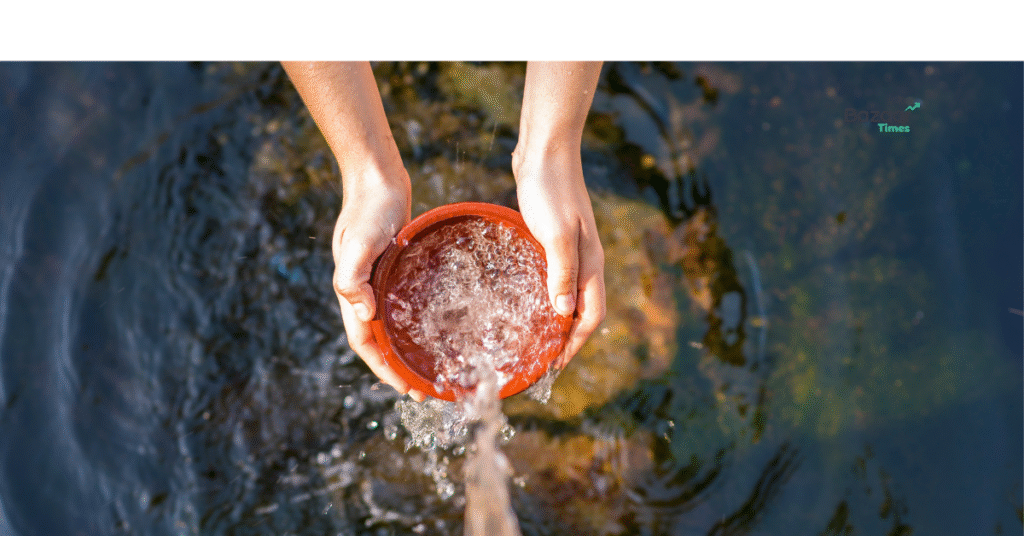
Introduction: Every Drop Counts.
Water is life, and in India it is turning out to be one of the most precious resources of the 21st century.
India is a country with a population of more than 1.4 billion people and increasing industrial, agricultural, and urbanization needs: it is highly challenged as to how to utilize its water resources in a sustainable manner.
As described by the Composite Water Management Index in NITI Aayog, almost 600 million Indians are under high-extreme water stress, and by 2030, the water demand might be double that of the available water.
But amid such challenges, a silent revolution is in the process of taking place—driven by innovation, action on the part of the community, and green technology. With intelligent irrigation and AI-powered water tracking and rainwater harvesting, India is rethinking the way water can be conserved, reused, and respected using a single drop of water.
India Water Challenger: Its Wake-up Call.
Due to the rich rainfall received in India, the country is blessed with a rainfall of more than 4,000 billion cubic meters every year; however, it is not well managed and distributed, leading to serious shortages.
- About 80 percent of water is utilized in agriculture, with most of it going to waste as a result of poor irrigation practices.
- Cities waste up to 40 percent of treated water as a leakage and unregulated consumption.
- The loss of groundwater is quite terrifying, as the Central Ground Water Board (CGWB) has more than 1,000 blocks that are categorized as over exploited.
This crisis has brought about innovations and policy reforms that are geared towards sustainable use of water in the future.
Rainwater Harvesting: Best of Traditional Wisdom, Modern Design
Rainwater harvesting is considered to be one of the oldest and most effective water saving systems in India and it is now reappearing with a new face.
New buildings in cities such as Chennai, Bengaluru and Jaipur have been made to install rooftop rainwater collectors. It will guarantee local groundwater charging and minimize reliance on external sources.
- The city of Chennai has over 80 percent of the buildings equipped with harvesting systems enabling the city to overcome several droughts that have plagued the city.
- Rural Rajasthan has embraced the use of taankas (underground storage tanks) and check dams which trap the monsoon water to be used throughout the year.
- Housing societies and corporations are developing combined rainwater systems that have the ability of filtering, storing and reusing water efficiently.
Such a combination of ancient knowledge and intelligent technology is making rain a sustainable commodity.
Smart Irrigation: Water Saving, Yields Increase.
It is agriculture that drinks up the lion share of Indian water – and thus has the answer to conservation.
The advent of new irrigation technologies makes farmers change their use of water:
- Water is discharged to the roots, rather than scattered in the air, through drip and sprinkler systems which cut down on wastage by up to 60%.
- IoT soil sensors help to measure the moisture level and can automatically activate irrigation when necessary.
- The use of AI and satellite information allows farmers to take the forecasts of rainfall and water utilisation.
Plans such as Pradhan Mantri Krishi Sinchai Yojana (PMKSY) are supporting the Per Drop, More Crop – a concept that encourages valid irrigation.
An example is farmers of the Nashik district of Maharashtra who have been irrigating by means of smart pumps reported increasing incthe Nashik yields by half the amount of water used.
These innovations will not only guarantee the sustainability of water in India but also make it profitable to the farmers of India.
Recycling and Reuse of Wastewater: Recycling Waste to generate Wealth.
In India the amount of wastewater generated almost 72,000 million liters of wastewater is treated on a daily basis- majority of the wastewater produced is not treated. However, the cities are currently transforming this issue into opportunity by providing sophisticated wastewater recycling technologies.
- Indore and Surat have almost 100 percent sewage treatment and the water is used to irrigate the land, in industries and to build constructions.
- Nagpur operates the first large-scale sewage to drinking water project in India, which treats 200 million liters of water per day.
- In housing complexes and hotels, private startups are recycling the grey water by membrane filtration, UV treatment, and nanotechnology.
Wastewater recycling is now a large sector of the Indian circle economy – lessening water requirements and pollution, as well as enhancing sustainability.
Smart Water Management: technology meets conservation.
Digital transformation is transforming the city and industry way of handling water.
Smart water management is a concept based on IoT sensors, AI, and data analytics to measure water flow, leakages, and supply network optimization.
- Smart meters are monitored in Pune and Bengaluru and the utilization is monitored in real-time, allowing to curtail the wastage to 2030%.
- Delhi NCR has hydroinformatics systems that identify underground leaks by sensor and satellite imagery.
- Intelligent dashboards enable the cities to track the quality of water, pressure and storage in real time.
These new inventions are also making the urban systems in India more efficient, transparent, and responsive.
Groundwater Recharge and River Basin Restoration.
India still depends on groundwateras the largest water source, which serves 85 percent of rural and 50 percent of urban urbgroundwaters putting in place huge recharge schemes to rehabilitate it.
- Through the Atal Bhujal Yojana, which is a project funded by the World Bank, there is encouragement of groundwater management at the community level in seven states.
- In the country, check dams, percolation tanks and recharge wells are being constructed to restore aquifers.
- The flagship river rejuvenation program called Namami Gange in India is an amalgamation of river cleaning, protection of catchment areas and wastewater treatment.
These projects are working together to restore the hydrological balance that is that the succeeding generation will not have scarcity but rather sustainability.
The Corporate and Community Leadership.
In addition to government initiatives, the corporates and communities are making proactive initiatives to save water.
- ITC, Tata Steel and Coca-cola India have all gone water positive that is, they have been found to replenish more water than they use.
- NGOs and local communities are restoring past water bodies lakes, ponds and wells that disappeared as a result of neglect.
- The ministry of Jal Shakti through the campaign called Catch the Rain urges all citizens to collect rain regardless of its location.
These mass actions reinforce a significant point; water conservation starts with awareness and responsibility.
Future Innovations.
The next-generation technologies will define the future of water management in India, and they include:
- Drought predictive analytics based on AI.
- Cities on the coast are equipped with desalination plants.
- Atmospheric water generators (AWGs), which absorb water in air.
- Water trading and allocation blockchain.
These innovations have been bringing the water sector in India to pace with the world in the sustainability process and to the United Nations Sustainable Development Goal (SDG) 6: Clean Water and Sanitation available to all.
Hardships and the Golden Road
Nevertheless, the water voyage in India is not over. Challenges include:
- Poor allocation of water among states.
- Poor city infrastructure.
- Drought and floods as a result of climate change.
- India shtanks,keep on overcoming them by:
- Consstinks; keepr resource management (IWRM).
- Increase rural water supply system under Jal Jeevan Mission.
- Stimulate large-scale water innovation through public- private partnerships.
Through collaboration, innovation and community involvement, India can have water security and sustainability to all.
Summary: A Future Built on Every Drop.
The water conservation process of India has been an embodiment of the strength of innovation, perseverance and awareness.
Every step taken by rural farmers to go smart in irrigation or even by urban designers to make drainage systems sustainable is a step in a nationwide water stewardship movement.
India does not need as much water as it has, but it will need to use it wisely. Now with technology fused with the old-fashioned wisdom, India is showing that every drop counts – and every action is.
India is no longer a dream of having a sustainable and water-secure nation; however, one step at a time, it is turning into a reality.